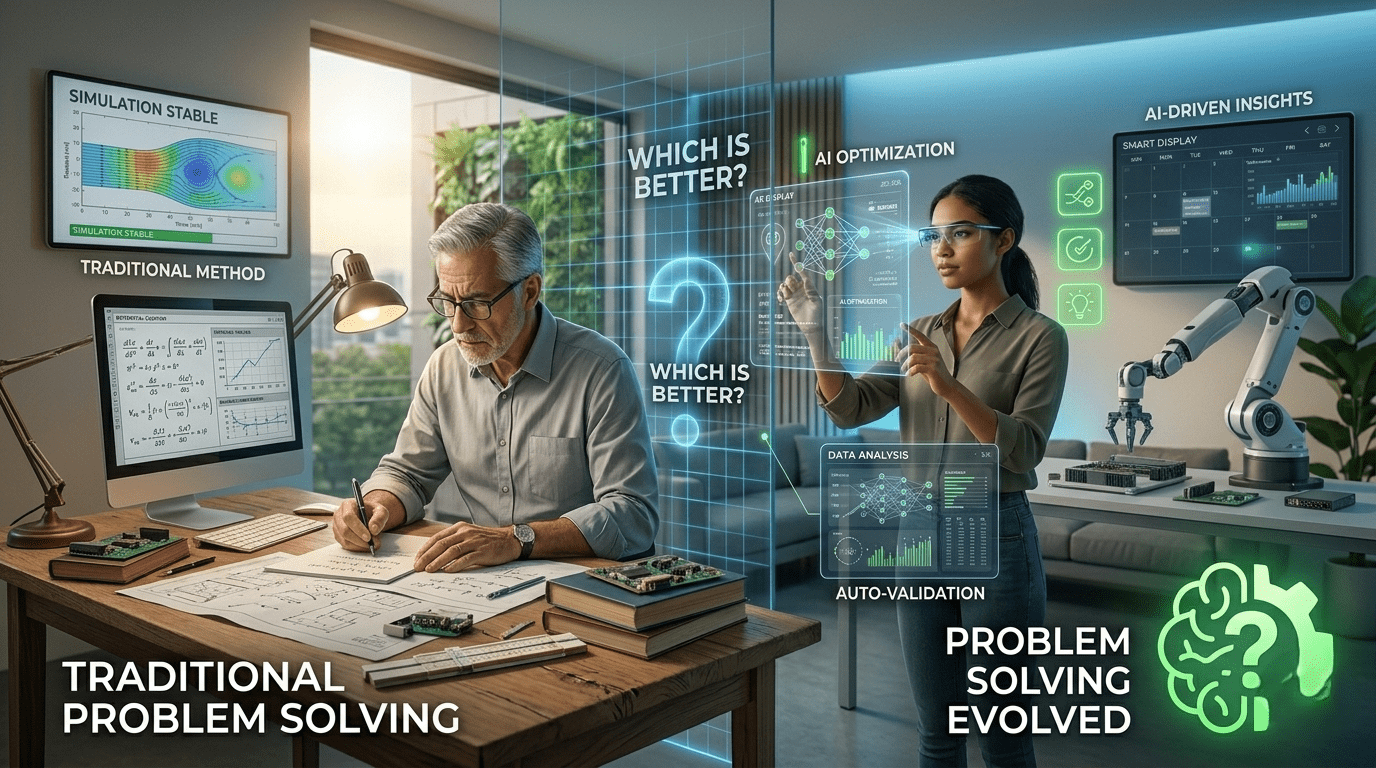
Problem solving is a core skill in every field, from education and business to software development and engineering. In recent years, Artificial Intelligence (AI) has transformed how problems are solved, offering faster and more automated solutions. However, traditional problem-solving methods still play a vital role in critical thinking and decision-making.
So, which is better—AI or traditional problem solving? The answer depends on the situation, complexity, and goals of the task.
What Is Traditional Problem Solving?
Traditional problem solving relies on human intelligence, experience, and logical thinking.
Key Features:
- Human decision-making
- Step-by-step analysis
- Experience-based solutions
- Manual research and testing
Example:
A technician manually diagnosing a computer issue by checking hardware and software step by step.
Traditional methods are slow but highly reliable for complex or unique situations.
What Is AI-Based Problem Solving?
AI problem solving uses machine learning algorithms and data analysis to find solutions.
Key Features:
- Automated decision-making
- Data-driven analysis
- Pattern recognition
- Fast processing
Example:
An AI system detecting system errors and automatically suggesting fixes.
AI is fast, scalable, and efficient for repetitive tasks.
Speed Comparison
AI:
- Processes large data instantly
- Provides real-time solutions
- Automates repetitive tasks
Traditional:
- Requires manual effort
- Takes more time for analysis
- Depends on human availability
Winner:
👉 AI is faster in most cases
Accuracy Comparison
AI:
- Highly accurate with large datasets
- May produce errors if data is incorrect
Traditional:
- Based on human judgment
- More reliable in unfamiliar situations
Winner:
👉 Traditional methods are more reliable in complex, unique problems
👉 AI is more accurate in structured tasks
Creativity and Flexibility
AI:
- Limited creative reasoning
- Works based on existing data
Traditional:
- Strong human creativity
- Can think outside the box
- Adapts to new situations easily
Winner:
👉 Traditional problem solving
Cost and Efficiency
AI:
- Reduces labor costs
- Automates repetitive work
- Efficient at scale
Traditional:
- Requires more human effort
- Higher time and resource usage
Winner:
👉 AI is more cost-efficient for large-scale tasks
Real-World Decision Making
AI:
- Best for:
- Data analysis
- Automation
- Predictive systems
Traditional:
- Best for:
- Strategic decisions
- Ethical considerations
- Complex human judgment
Winner:
👉 Both are important depending on context
Advantages of AI Problem Solving
- Faster results
- Handles large data easily
- Reduces human workload
- Works 24/7
- Improves efficiency
Advantages of Traditional Problem Solving
- Strong critical thinking
- Better ethical judgment
- More flexible in unknown problems
- No dependency on technology
- Encourages learning and experience
Limitations of AI
- Requires data to function
- Can make biased decisions
- Lacks human emotions and intuition
- May struggle with complex unknown scenarios
Limitations of Traditional Methods
- Time-consuming
- Prone to human error
- Limited by knowledge and experience
- Not scalable for large systems
AI vs Traditional: Which One Is Better?
There is no single winner. The best approach depends on the situation.
Use AI when:
- You need speed
- Working with large data
- Automating repetitive tasks
Use Traditional Methods when:
- Problem requires creativity
- Ethical judgment is needed
- Situation is complex or unknown
The Best Approach: Combining Both
The most powerful solution is combining AI with human intelligence.
Hybrid Approach:
- AI handles data and automation
- Humans handle creativity and decisions
- Together they produce better results